IMPROVE MY GAME
Articles
The Coaching Code by Mark Blackburn: Never Stop Testing What You Know
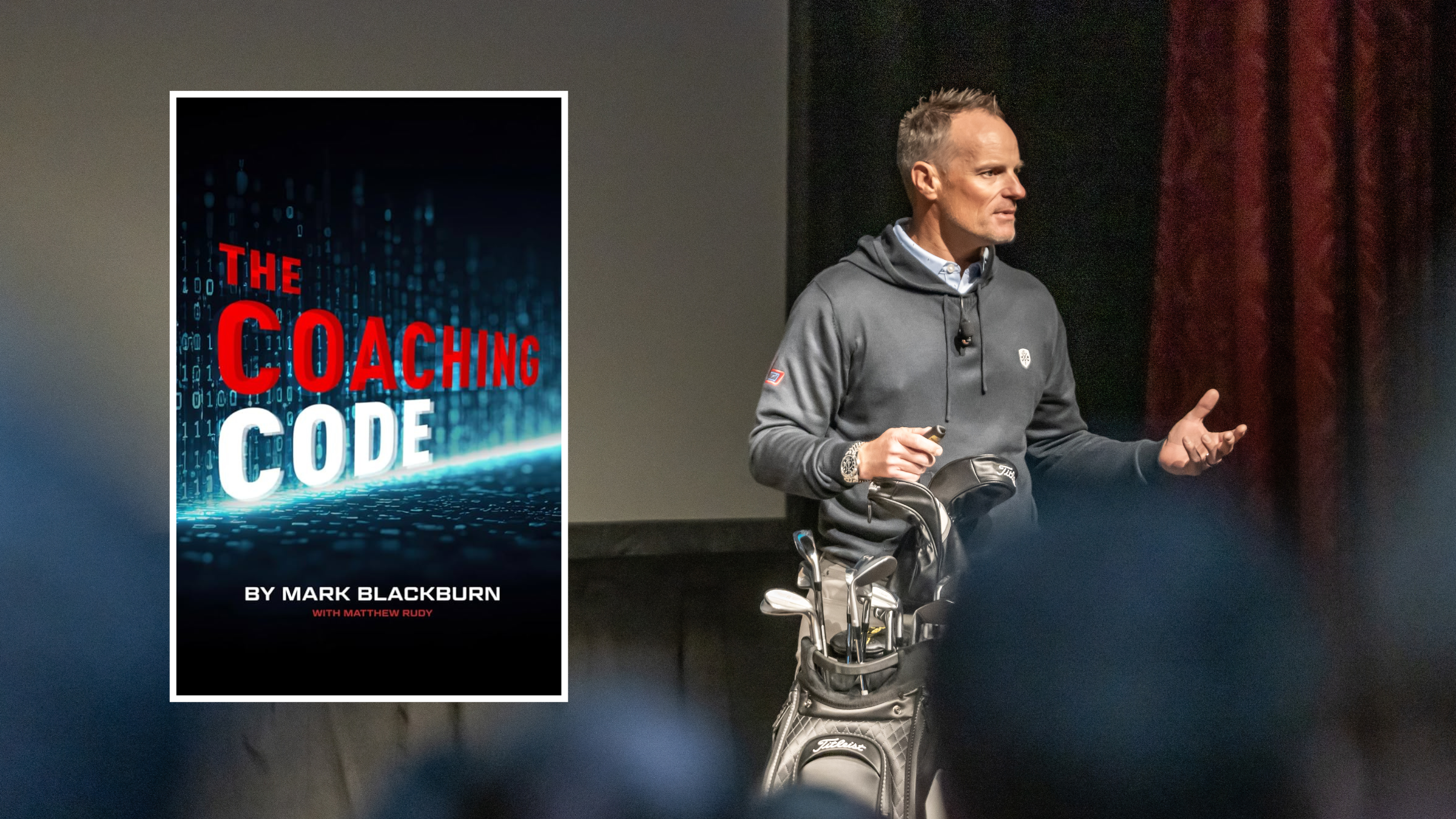
The following is an excerpt from Mark Blackburn's recently published book, The Coaching Code.
Mark is widely recognized as one of the best golf coaches in the world, earning PGA of America Coach of the Year honors and ranked as Golf Digest's #1 Teacher in America.
A TPI Advisory Board member, longtime seminar presenter and contributor to our advanced certification curriculum, Mark has helped shape the way thousands of coaches understand movement, mechanics and on-course performance.
His work with some of the world’s best players - including multiple PGA TOUR winners - reflects the same principles he has helped us champion for over a decade: assess first, coach with clarity and build solutions tailored to the athlete.
In this preview chapter from The Coaching Code, Mark shares the philosophy and practical framework that have made him one of the most influential coaches in the game.
When I think about the more influential teaching experiences of my early career, two of them immediately stand out.
In the very early days, I went down to Orlando to attend Mac O'Grady MORAD golf school in Orlando. Mac is certainly a genius, and he's one of the most influential coaches in the last 50 years of golf instruction. What he figured out without modern technology—and his ability to teach it ambidextrously—was remarkable.
Besides being a terrific player who won on the PGA Tour, he is a relentless thinker, with volumes of ideas on the swing. But the event I saw was chaotic. It had coaches and regular players mixed together, and he was discussing a series of complicated models he had developed around centrifugal and centripetal force. The information was fascinating—and groundbreaking—but he was adamant about applying the same model to a 70-year-old in the group as he did to a fit tour player in his 20s. Pragmatically, this was just not viable or realistic for everyone. A model is a lovely idea, but the reality is that every one of us is an N of 1, so to speak.
My education was in exercise science and coaching, but it wasn't until I began coaching Robert Karlsson in the mid-2000s and through Titleist met Greg Rose and Dave Phillips at TPI that I really began to see the application of what I learned in school from a movement perspective in golf.
Mac's MORAD research and Homer Kelley's Golfing Machine concepts gave me some grounding in the technical elements of the swing. The Golfing Machine offered lots of different pattern variations to successfully swing the club, and I think one of my early strengths was the ability to help players find match ups that worked best for them. And then I was able to get exposure to the physical side and movement screening at TPI. Seeing what TPI screening did for Robert made it clear that it would be a foundation for what I taught and how I coached.
You can have the best processes in the world, and the best information, but if people can't physically do what you're asking them to do, it will ultimately be unsuccessful.
Everything you do will be back-filling to provide compensation after compensation.
This is immediately obvious with amateur players with more limited physical tools, but it gets more complicated when you work with elite athletes. With them, not everything is a purely physical thing. An elite player might have a technically inefficient swing but get excellent results because he or she is a tremendous athlete with amazing coordination and sense for the clubhead. They could be completely dysfunctional in terms of movement, but apply the right force at the right time and hit amazing shots. But that falls apart when the player's body stops complying. They might have a motion that makes them prone to injury, or they simply get injuries and limitations that come with getting older.
Those early experiences taught me something fundamental about coaching that I carry with me. You must constantly verify your work. No matter how certain you are, how experienced you become, or how successful your methods have been in the past, verification is non-negotiable when you're responsible for a player's livelihood and career. Change is inevitable, of course, and the coach's job is to evolve and adapt to those changes.
Working with elite players raises the stakes exponentially. These athletes compete for millions of dollars, legacy-defining championships, and their place in history. The margin between success and failure is so thin that a single shot over four days can mean the difference between winning and losing, between a life-changing payday and relative anonymity.
In that environment, being “pretty sure” isn’t good enough.
Hunches and intuition that come from experience might have a place, but they must be backed by rigorous verification systems that protect both you and your player from costly mistakes.
At 6-foot-5, Robert Karlsson is an imposing guy, but he struggled with limited torso rotation and the ability to separate his lower body from his upper body in transition.
That meant his swing tended to be very steep, - which wasn’t good on his body or for his ball-striking. He hit a lot of foul balls with the driver and missed lots of greens, neither of which is good for longevity on the Tour.
He had lots of backwards bend in the backswing and an upper body dominated downswing, which might be good for certain players but a bad prescription for him.
We improved his torso range of motion and shortened his backswing, which let him start his lower body earlier. This dramatically improved his sequencing and allowed him to plane the club beautifully. He became a ball-striking machine, and in our second year together, he won multiple times, captured the DP World Tour Order of Merit,. He ultimately made it inside the top ten in the world and onto the European Ryder Cup team.
That's the ultimate validation of the Body-Swing Connection.
Now, the checks and balances I use work in two pathways: verifying what I'm doing with a certain player, and relentlessly expanding my knowledge. I always want to stay aware that there's always much more to discover and learn.
First, I document everything. Every observation, every intervention, every drill, every goal. I take videos not just of their swings but of our sessions. I record the exact language I use to help me remember what influenced the outcome.
Second, I establish baseline measurements before making any significant change. Using physical screens, launch monitors, 3D motion capture, force plates, and a variety of analytics, I create a comprehensive picture of the player's current performance. This allows me to objectively determine whether our interventions are creating the intended effect rather than just guessing.
Physically screening golfers requires a small investment of time on the front end, but can ultimately produce better outcomes for the coach and student.
— TPI (@MyTPI) October 19, 2022
Asking a golfer to do something their body won’t let them do is the recipe for a bad lesson.
🗣: @blackburngolf at Golf 3 pic.twitter.com/ZRCVm2gekR
Third, I build in regular review periods that force me to critically examine our direction. improvement. These aren’t casual check-ins - they're structured around the effectiveness of my coaching. I'll reach out to other coaches and performance experts I trust to give consultative opinions and serve in that role when they check their own work.
Fourth, I intentionally use error as a feedback tool. As we're working on an improvement, I'll periodically ask a player to go back and do something the wrong way so we can evaluate it relative to what's happening now. It shines a light on the old and new and helps us confirm that the solution is the correct one.
Whether you can walk inside the ropes or not, having a comprehensive approach to verification is definitely not easy. It takes time, energy, and a willingness to be wrong. It means sometimes taking a step back when you'd rather push forward. It requires investment in technology, in education, and in building relationships with other experts who can check your work.
But the alternative - coaching without verification- is coaching by hope. You're essentially saying, 'I think this is right, and I hope it works out.' At the Tour level, hope isn't a strategy. The stakes are too high, the competition too fierce, the margins too thin.
The coaches who thrive long-term at the highest levels aren't necessarily those with the most innovative techniques or impressive client lists. They're the ones who are constantly testing, measuring, questioning, and refining. They're serious about checking their work as their players are about checking their fundamentals. And in both cases, that discipline is what separates the elite from the merely good.
View TPI Level 1 Online Course
If you're a golfer interested in a physical assessment, you can connect with a TPI Certified expert via our Find an Expert page.