IMPROVE MY GAME
Articles
Why the Lower Back is Often the Victim, Not the Culprit
Lower back pain is one of the most common complaints among golfers. It consistently ranks as the number one injury reported by both amateur and professional players.
When golfers experience pain in the lower back, the instinct is often to treat the location of the pain itself. But in many cases the lower back is not the true source of the problem.
At TPI we often say that the lower back is the victim, not the culprit.
The lumbar spine frequently becomes painful because it is forced to compensate for limitations elsewhere in the body during the golf swing.
To understand why this happens, it helps to first understand what the lower back is designed to do.
Common Physical Limitations That Lead to Lower Back Pain
In our Level 1 online course, we introduce a concept called the Joint by Joint Approach, originally coined by our friends Mike Boyle and Gray Cook.
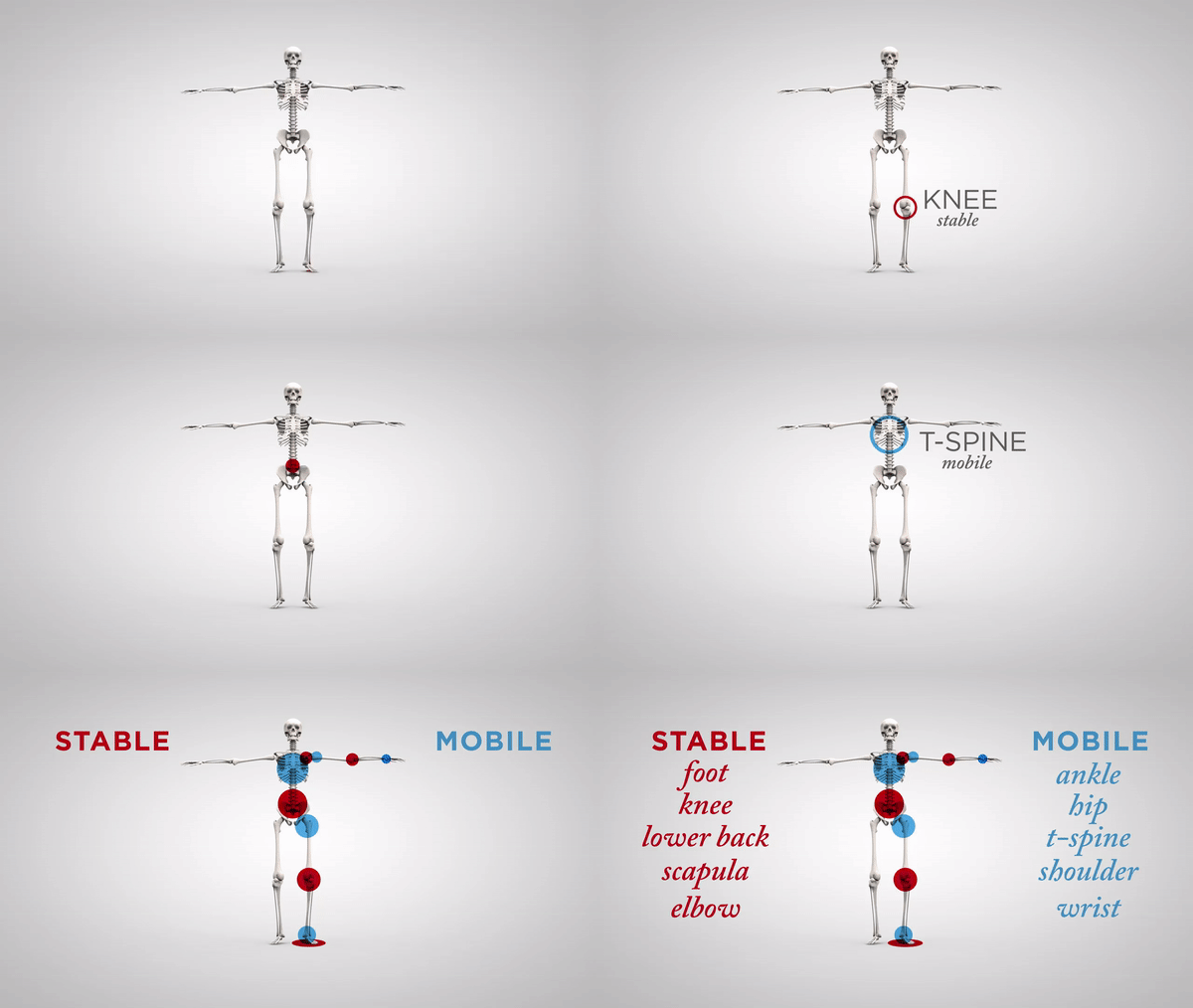
The Joint-by-Joint Approach describes how the body alternates between joints designed for mobility and stability, and when mobility is lost in areas like the hips or thoracic spine, the lower back often compensates.
With regards to the golf swing, lumbar spine acts a stable segment, not a rotational center.
Most of the rotational motion required should come from the hips, thoracic spine and shoulder.
When these areas lack mobility, the body often finds a way to complete the swing by borrowing motion from the lower back.
Over time this compensation can place excessive stress on the lumbar spine and lead to pain.
Limited Hip Mobility
The hips play a major role in producing rotation and force during the golf swing.
If a player lacks mobility in the hips, particularly internal rotation of the lead hip or internal rotation of the trail hip, the body may compensate by increasing motion in the lower back.
This is one of the most common patterns we see when screening golfers with back pain. In fact, we've found that roughly 60% of golfers we've evaluated who are complaining of lower back pain also present with signficant hip restrictions.
When the hips cannot rotate effectively, the lumbar spine often rotates more than it should.
Poor Thoracic Spine Mobility
Another common contributor to back pain is limited mobility in the thoracic spine.
The thoracic spine is designed to rotate significantly during the swing. If that rotation is restricted, the body may again attempt to create motion somewhere else.
Frequently that motion comes from the lower back. In a high-velocity, high-volume sport like golf, this repeated stress can irritate the joints and tissues of the lumbar spine.
This is why we preach the importance of physical assessments and why the hips and thoracic spine are a key focus of the TPI screen.
If the thoracic spine and hips are not working well, the lumbar spine often has to work too hard. The body part that does the most work is what is most likely to break down. It's the victiim of lazy neighbors.
As we like to say in our advanced Medical courses, as a practitioner, you should never chase pain.
Swing Characteristics That Increase Stress on the Lower Back
Movement limitations are only part of the equation. Certain swing patterns can also increase lumbar stress.
Some common examples include:
If a player tilts excessively toward the target at the top of the backswing, it can place additional stress on the lower back during transition. In our experience, this is the swing characteristic most-closely associated with lower back pain.
S-Posture itself isn't terribly stress-inducing, but it often limits hip rotation and increases the likelihood of Early Extension or Reverse Spine.
Excessive X-Factor
The ability to separate the upper body and lower body (x-factor) can help a golfer engage the oblique abdominals and generate rotational velocity of the trunk. However, golfers who create significantly more than 45° degrees of separation may create excessive stress (this was the case with Patrick Cantlay when we first assessed him).
Why Assessment Matters
Lower back pain in golfers rarely exists in isolation. Therefore, simply treating the site of pain may not fully resolve the problem.
Instead it is important to evaluate the entire movement system. In many cases the lumbar spine is simply responding to movement restrictions elsewhere in the body.
By improving mobility in the hips and thoracic spine, and addressing swing mechanics when necessary, golfers can often reduce stress on the lower back and improve both performance and durability.
Remember that the lower back is often the victim, not the culprit.
Understanding why that happens is the first step toward keeping golfers healthy and playing the game for years to come.
If you're a golfer interested in a physical assessment, you can connect with a TPI Certified expert via our Find an Expert page.